The Permanent Final Round: Talks as an Institution
The Gaza talks in Egypt have reached the final round again — the same final round they started in. The hub file on negotiations that never end, because ending them is nobody's job.
In boxing, “final round” means someone will be on the canvas within minutes. In Middle East diplomacy, “final round” means please book the hotel for the next final round as well.
June 2026, Egypt. The delegations arrived, shook hands, posed for photographs, and stalled on the same three files they have been stalling on from day one: Hamas disarmament, Israeli troop withdrawal, and who governs Gaza the morning after. That is not this site’s flourish; it is the sober finding of ACLED’s Middle East overview and the July forecast of the Security Council Report. Three questions, three walls. And an entire industry built around those walls.
Look closely at the industry. The conference hall, the microphone forest, the closing statement with its magic sentence: “progress was made.” Progress toward what? Toward the next round. A negotiation that stays “final” for years is no longer an event; it is an institution — with a budget, a calendar, and a rotation of studio experts. And institutions obey one iron law: no institution schedules a meeting to abolish itself.
Now the tell-tale detail that gives the stage set away. In the very month the delegations discussed maps, the map was being redrawn. Israeli military activity dropped roughly 20 percent in June — but what remained was concentrated on consolidating the so-called Yellow Line, the line quietly hardening into a border. We unpack it in the cartography of the Yellow Line. At the table, the map is debated; on the ground, the map is drawn. These are two different jobs, and only one of them requires a communiqué.
The money side keeps its own books: reconstruction is promised, but as long as the governance file stays open, the “delivered” column stays blank — we keep the accounts in the reconstruction ledger. And if you want to know what a ceasefire that actually moves numbers looks like, compare the northern file: the Washington agreement of June 3 between Israel and Hezbollah, and violence statistics that genuinely fell. That comparison lives in the Lebanon quiet file.
The language of these talks is a performance of its own. “Final round,” “constructive discussions,” “the window remains open” — each phrase performs the same trick: it reports failure in the grammar of success. We keep a dedicated reference for this vocabulary, the euphemism dictionary.
Here is the analytical point, delivered without a smile: the permanent final round is not the failure of negotiation — it is its function. As long as the final round continues, nobody has to answer the three founding questions. The endless negotiation is a waiting room in which the status quo becomes a few centimetres more official every day. Whoever is comfortable with the status quo is comfortable with the next round too.
So the next time a headline announces “decisive round of talks begins,” allow yourself the smile — then ask two questions. How many “decisive” rounds does this make? And what moved on the ground between the last two? The answer to the second question is the news. Everything else is set design.
The Gaza cluster files
This page is the hub of the Gaza cluster. Its files: the cartography of the Yellow Line, the reconstruction ledger, the Lebanon quiet file. For how this war is covered, read the victim hierarchy.
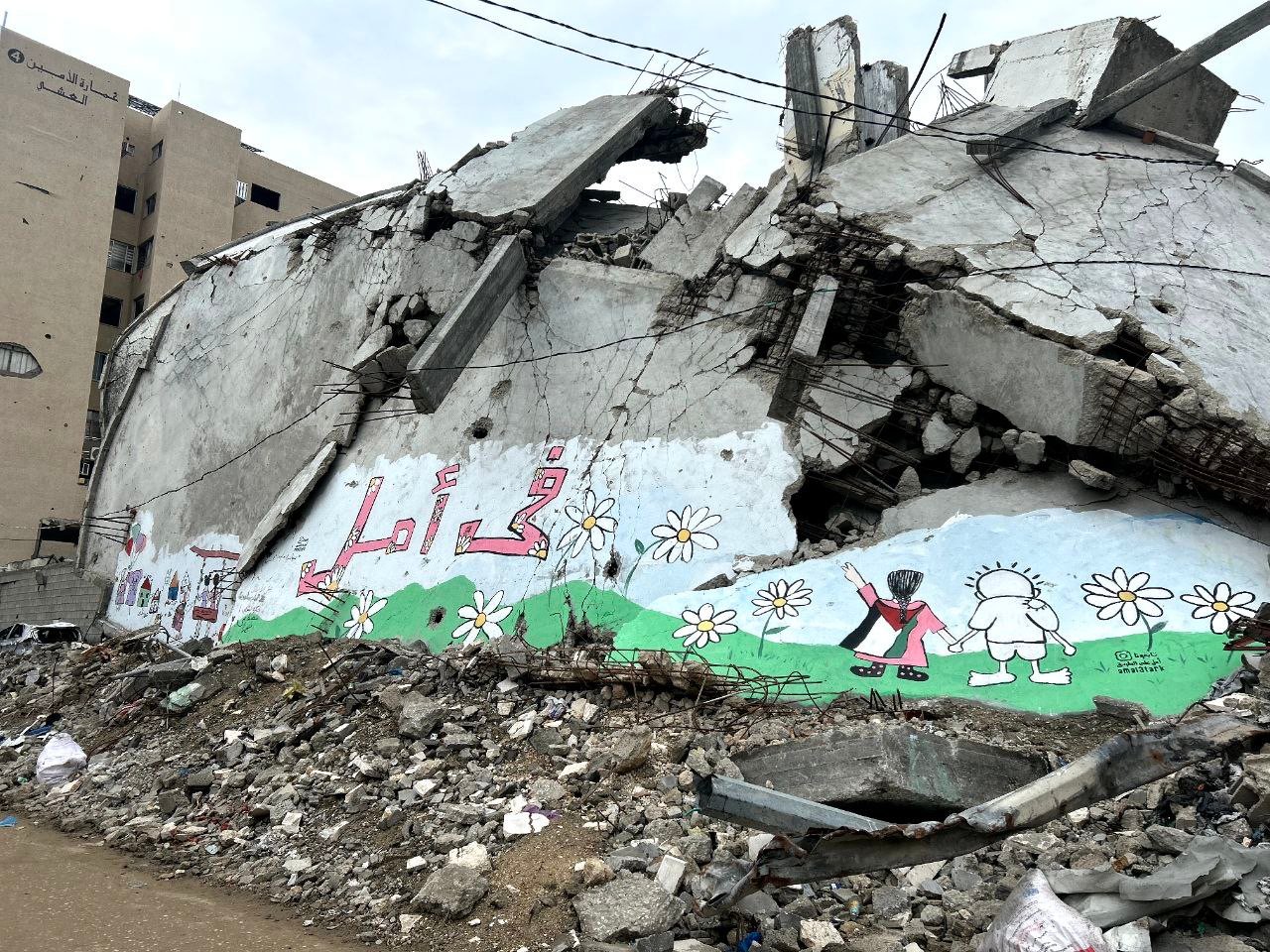
Header photo: mural on a bombed building, Al Thawra Street, Gaza — Hla.bashbash, Wikimedia Commons, CC BY 4.0.